Stucco Contractor & Plastering in Biggs, CA | Chico Elite Stucco

Chico Elite Stucco has been a stucco contractor for Biggs property owners for more than 15 years, working on homes, rental properties and commercial buildings whose walls stand close to ground that stays soaked for weeks at a time. Wet earth held against the foot of a wall keeps the plaster damp long after the surface looks dry, and plaster that cannot dry out softens, stains and crumbles at the bottom before it fails anywhere else.

We handle stucco repair, stucco resurfacing, stucco installation, removal and replacement, and remediation. Painting and coatings, inspection, stone veneer, decorative plaster and interior plaster are part of the same work, along with commercial and new-construction projects that need three-coat stucco planned from the wall framing out.

Farm ground around Biggs is flood-irrigated rice ground, deliberately held under water for part of every year, and the water table under a yard near it rises with the fields. Your wall has to keep its bottom edge clear of that wet soil. The California building code sets the edge at least 4 inches above the earth and at least 2 inches above paving, and we plan that clearance into the job before we start work on your walls.

We work throughout Chico and Butte County, including Oroville and the ridge communities, and we also serve parts of Glenn and Tehama counties. Give us a call at (530) 783-7384 or send a message through our online form and we will provide a free estimate on the work you need.

Get A Free Estimate

Why Choose Chico Elite Stucco for Biggs Stucco Work

  • We plan each job around the irrigation year, so the months when the ground stays wet are built into the schedule and the setup.
  • We have more than 15 years of stucco experience and are licensed and insured, with general liability and workers' compensation coverage.
  • Saturated soil is what we work around most weeks here, so a soft, wet yard changes nothing about how we protect the ground and set our equipment.
  • A written scope comes with your free estimate.
  • Cure times are minimums, and fresh stucco gets its full time to harden before anything goes on top of it.
  • One crew covers exterior plaster, trim and interior work.

Stucco Contractor Services for Biggs, California

Stucco Painting & Coatings

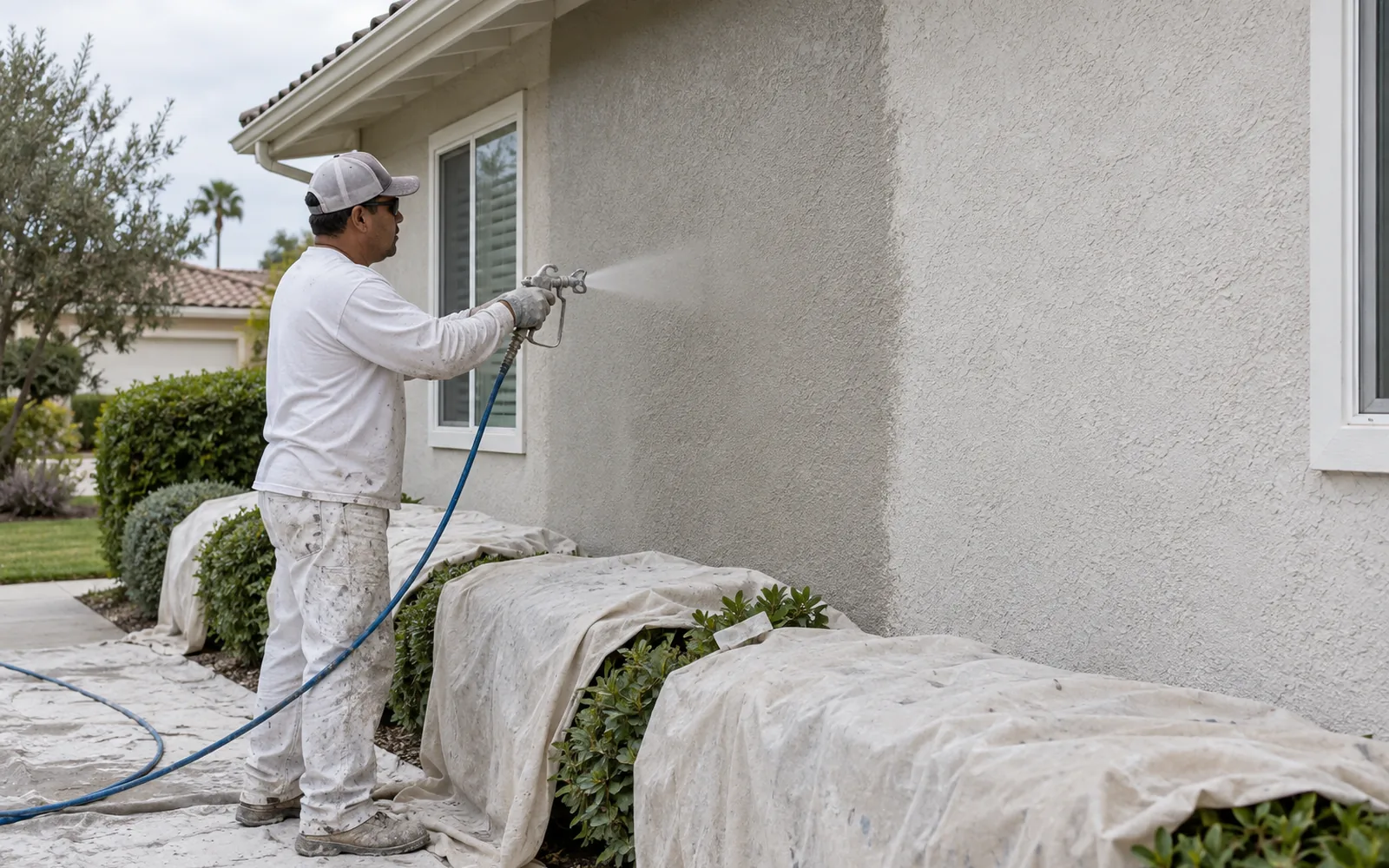
Worker spraying coating onto a house wall over drop cloths

We apply a coating over a wall that is already sound, and it renews color and helps the surface shed water. Elastomeric coatings stretch a little as the wall moves under heat and cold. Acrylic coatings are a tougher relative of house paint and hold their color well. Either one can keep a finish looking even for roughly seven to ten years, though a film on the surface cannot bridge a crack that keeps opening and closing, and it cannot dry out a wall that is already damp. Before we price a coating for you, we check the bottom of the wall and how water leaves the ground beside it, so nothing is sealed in behind the new surface.

Stucco Installation

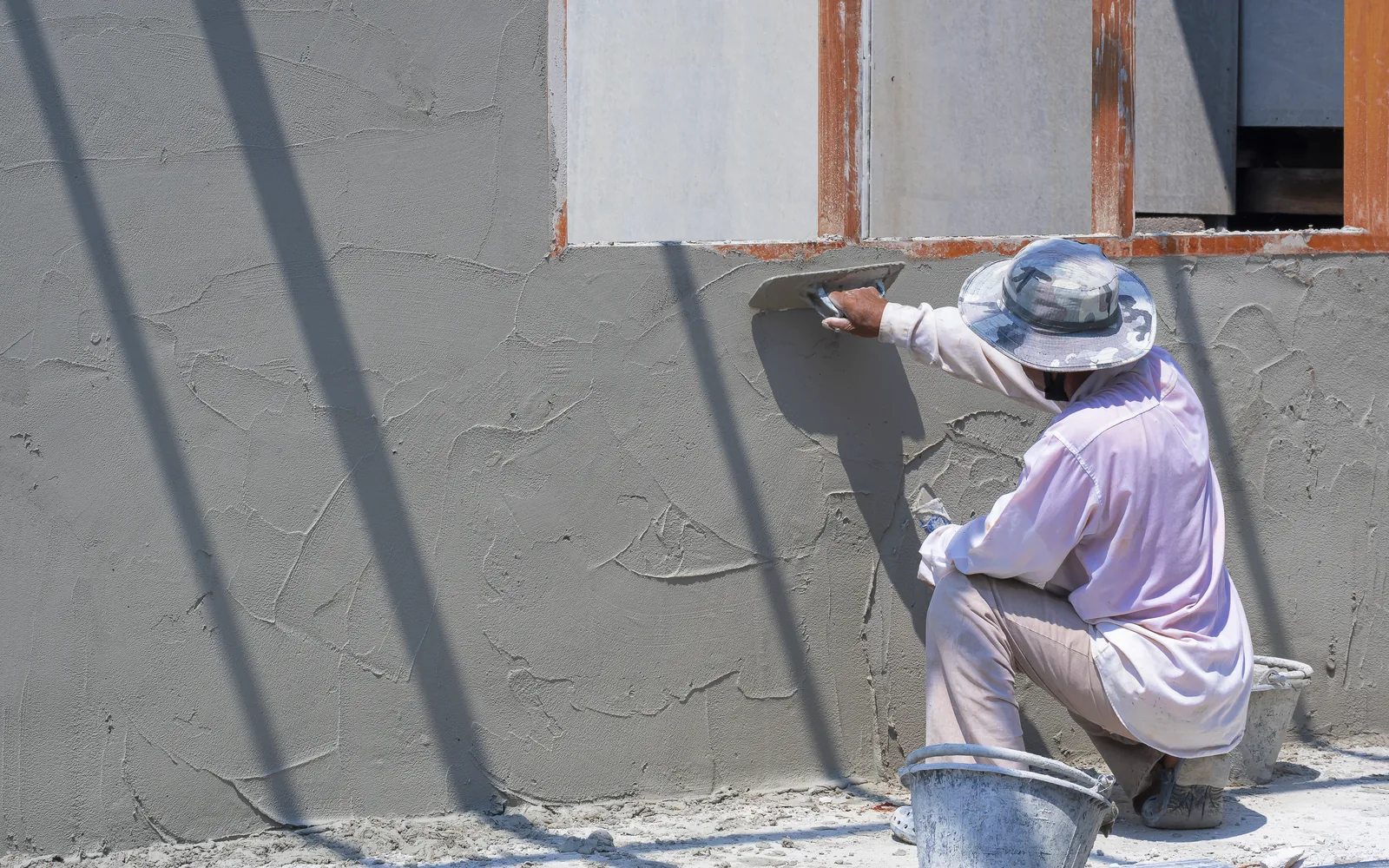
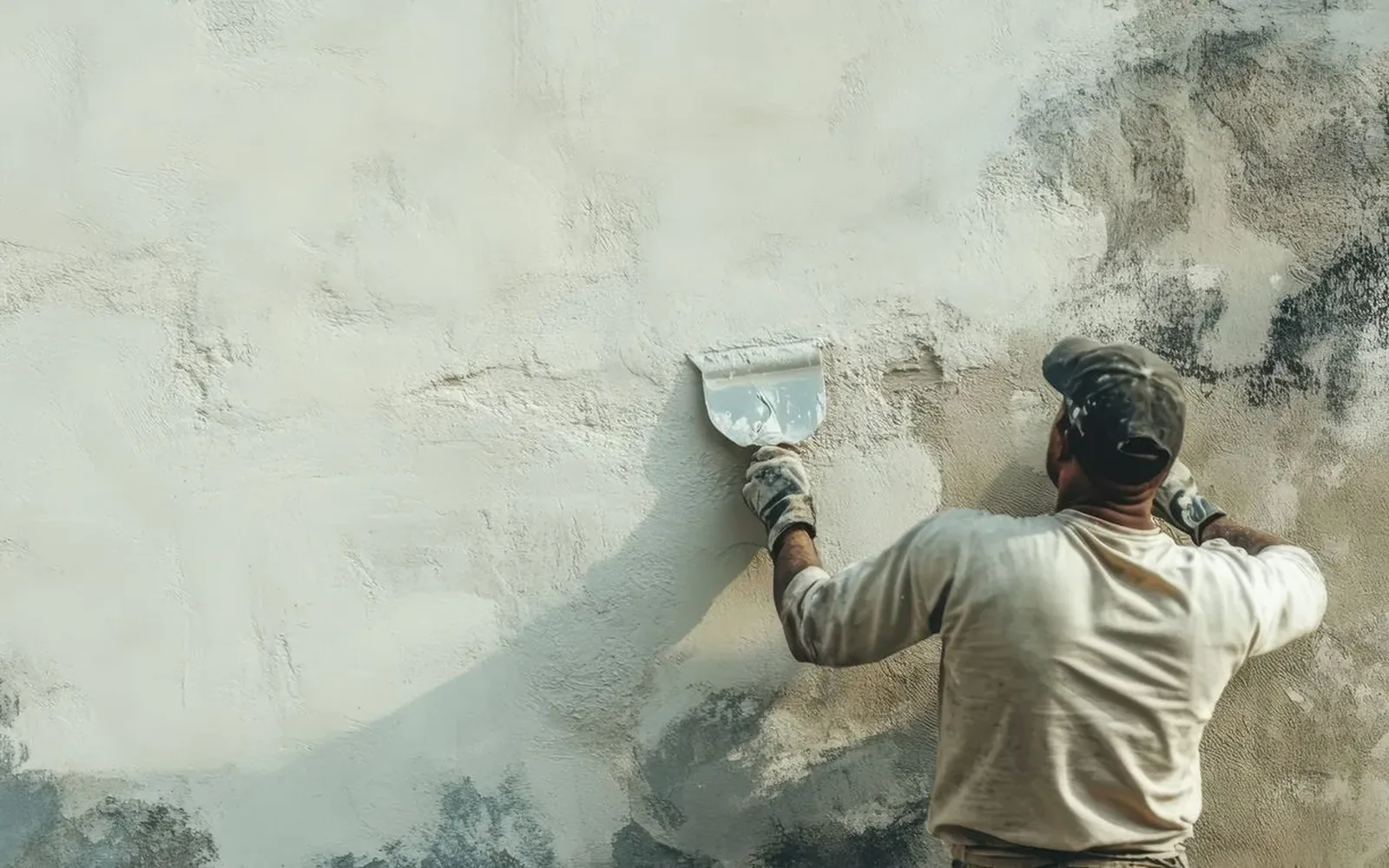
Plasterer in a sun hat troweling a large grey wall

We install three-coat stucco on new walls and additions. Before any plaster goes on, the wall receives a water-resistive barrier. That is a layer of building paper or wrap that catches whatever water gets past the plaster and carries it back out, keeping it off the wood behind. Over wood-based sheathing, California requires the equivalent of two of those layers behind stucco.

Metal lath goes on next, a steel mesh that gives the plaster something to grip. The scratch coat keys into that mesh, the brown coat flattens the wall and the finish coat gives the texture and color. Those three together come to a nominal 7/8 inch, and that thickness is what lets the wall take a knock and hold water off the lath. Code minimums require 48 hours of moist cure on each of the first two coats, 48 hours between the first and second coats, and 7 days before the finish coat. Those figures are minimums for your job, not a promised finish date.

Residential Stucco

Stucco home exterior with an arched entry and detailed trim

Most houses in town are single story, sitting on a slab or a low crawl space, so the bottom of the wall is close to the yard. Lawn irrigation and planting beds against the house can keep that lower band damp, which is why a repair at the base often pairs with nothing more than matched color and texture higher up. On an addition, we build a sample panel before the wall is finished so you can approve the match. Integral color is pigment mixed into the finish plaster itself, so the color is part of the material and a scuff does not show a different shade underneath.

Stucco Inspection

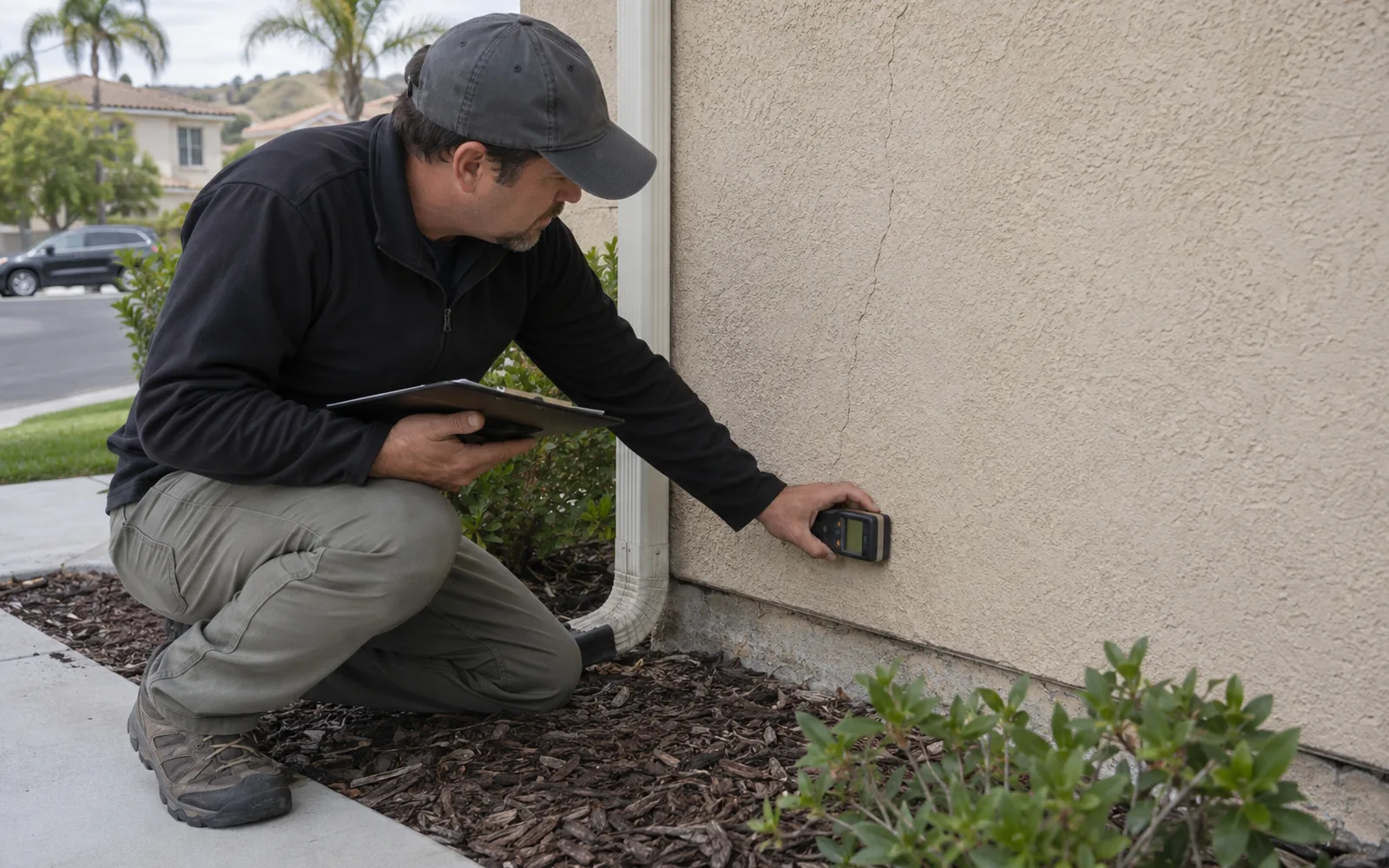
Inspector kneeling at a wall base with a moisture meter and tablet

An inspection on its own tells you whether you are looking at a cosmetic problem or a wet wall. It may include moisture readings at the wall base and around windows and doors, along with a tap test. When we do a tap test we listen for a hollow sound where the plaster has let go of the lath underneath. You receive written findings that name the condition we found. Owners ask for one before a sale, after a wet winter, or when the same problem keeps coming back.

Stucco Repair

Rebuilt stucco patch blended into the surrounding wall

We repair localized damage by cutting back to sound plaster and lath, then replacing the steel mesh where it has rusted through. A crack that keeps moving requires elastomeric sealant. That is a flexible joint filler that stretches with the gap instead of splitting across it. Impact damage requires polymer-modified mortar, a patching mortar with added binders that grips the old plaster. At the edge of town, farm equipment and vehicle strikes break corners and lower walls often enough to be a regular cause, and we work the texture back in once the damaged area is rebuilt.

Stucco Removal & Replacement

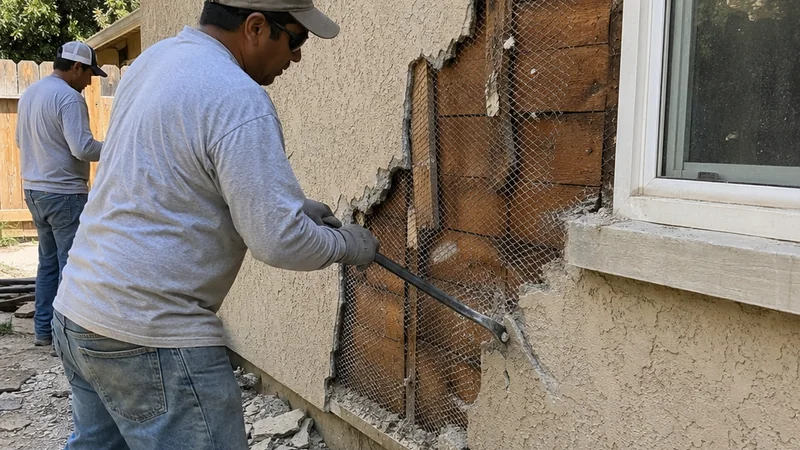
Cutting failed stucco away to expose the lath behind it

A wall that is past repairing needs to come off entirely. Tear-off runs one elevation at a time, so the building is never fully open. Once the old plaster is down, the sheathing and the framing behind it are inspected before new barrier and new lath go on. Sheathing is the wood skin of the wall, the surface the whole plaster system is built on. Construction from before 1980 gets tested for asbestos and lead before anything is disturbed. Biggs has enough older housing that this step is routine.

Stucco Remediation

Worker troweling fresh material over a water-stained wall

Some problems sit behind the plaster rather than on its face. Moisture is mapped before the wall is opened, and then we check that the barrier laps in the right direction so water runs down and out. Flashing is checked at the same time. Flashing is the metal or formed pieces that steer water away from windows, doors and rooflines, and it is often what needs rebuilding. Where mold is visible, a qualified independent specialist handles that assessment. With standing ground water nearby, drainage is the first thing we assess.

Commercial Stucco

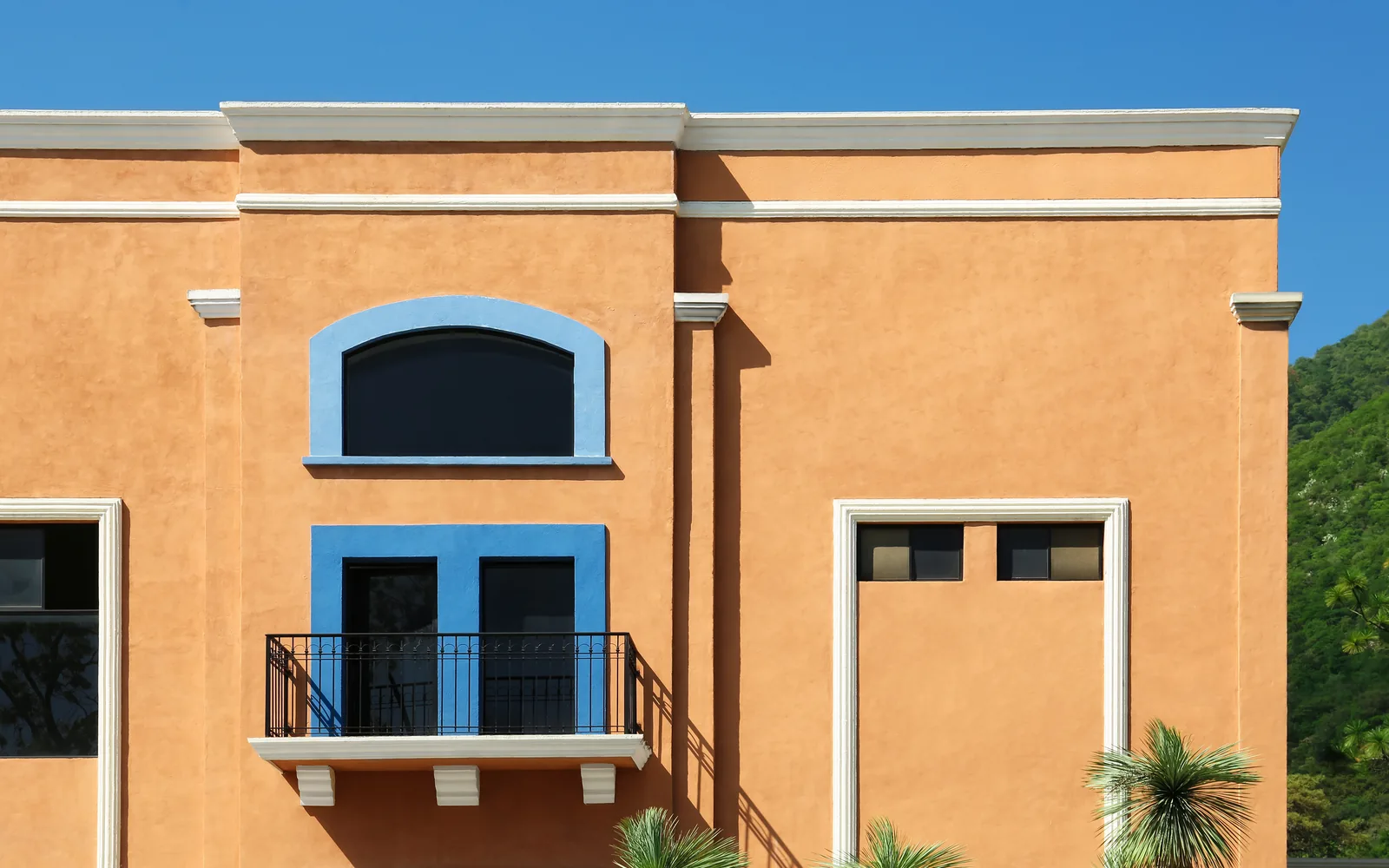
Orange stucco commercial building with a blue-trimmed arched window and balcony

Storefronts, retail shops, office buildings, restaurants, warehouses, agricultural offices and other commercial properties often need to stay open while stucco work is underway. We phase the elevations so customers, employees and deliveries can continue using the building, while scaffold and lift access is planned around entrances, parking areas and the public sidewalk. Dust control and careful staging also help keep plaster, debris and equipment away from open doorways, active work areas and shopfronts that people pass throughout the day.

Stone Veneer & Stucco

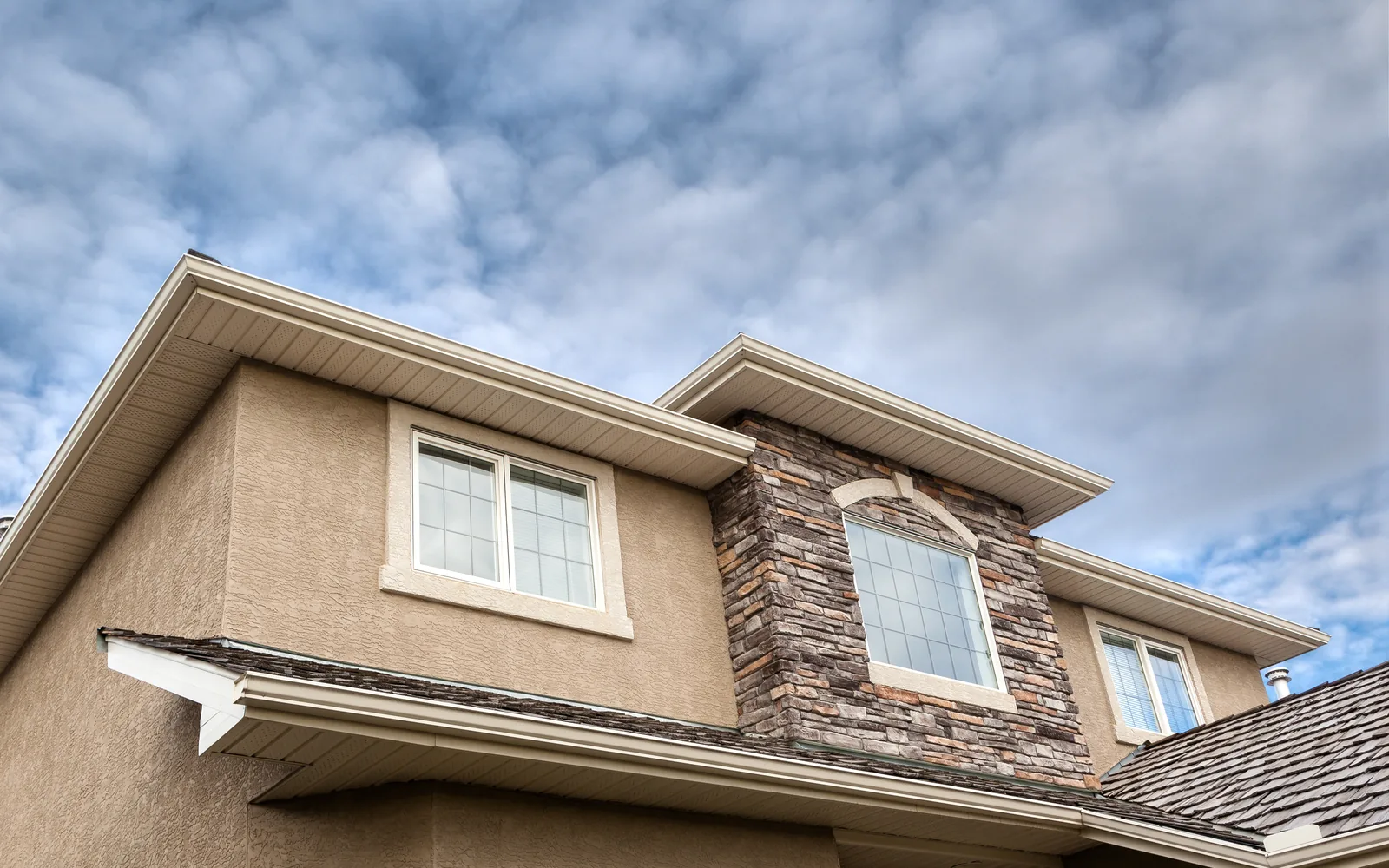
Two-storey stucco home with a stone-faced gable under cloud

We install adhered manufactured stone veneer alongside a plaster field as a wainscot, entry surround or column base. The stone veneer is applied over lath and a scratch coat, allowing it to bond into the same wall system as the stucco. A continuous water-resistive barrier runs behind both the stone and the stucco field to help manage moisture across the wall. Where the veneer ends, we also include a weep detail so any water that gets behind the finish has a clear path to drain out.

New Construction Stucco

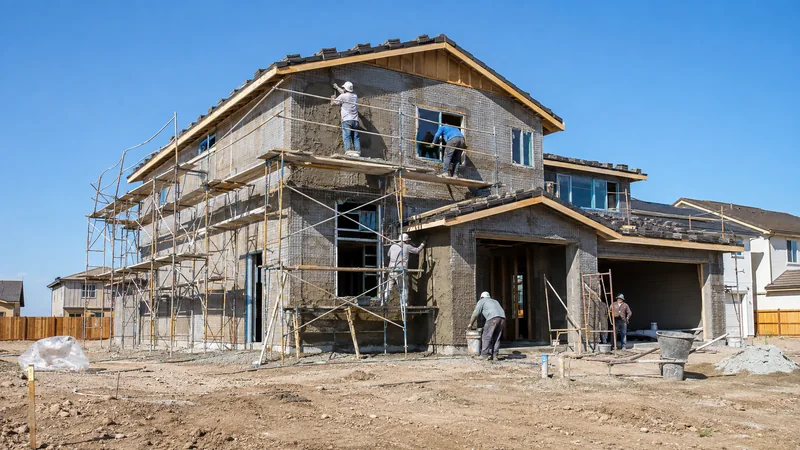
Stucco going up on a new building under construction

For new construction, builders and owner-builders usually bring us in before the wall assembly is covered. The lath inspection is a hold point, meaning the lath, flashing, water-resistive barrier and casing bead must all be in place and signed off before plaster work can move forward. Casing bead is the trim piece that gives the plaster a clean stop at an edge. Because this work overlaps with the window and roofing trades, we coordinate the flashing and barrier installation with their schedules rather than treating it as a separate step afterward. We also phase the elevations so one area waiting on inspection or another trade does not hold up the entire build.

Decorative Stucco

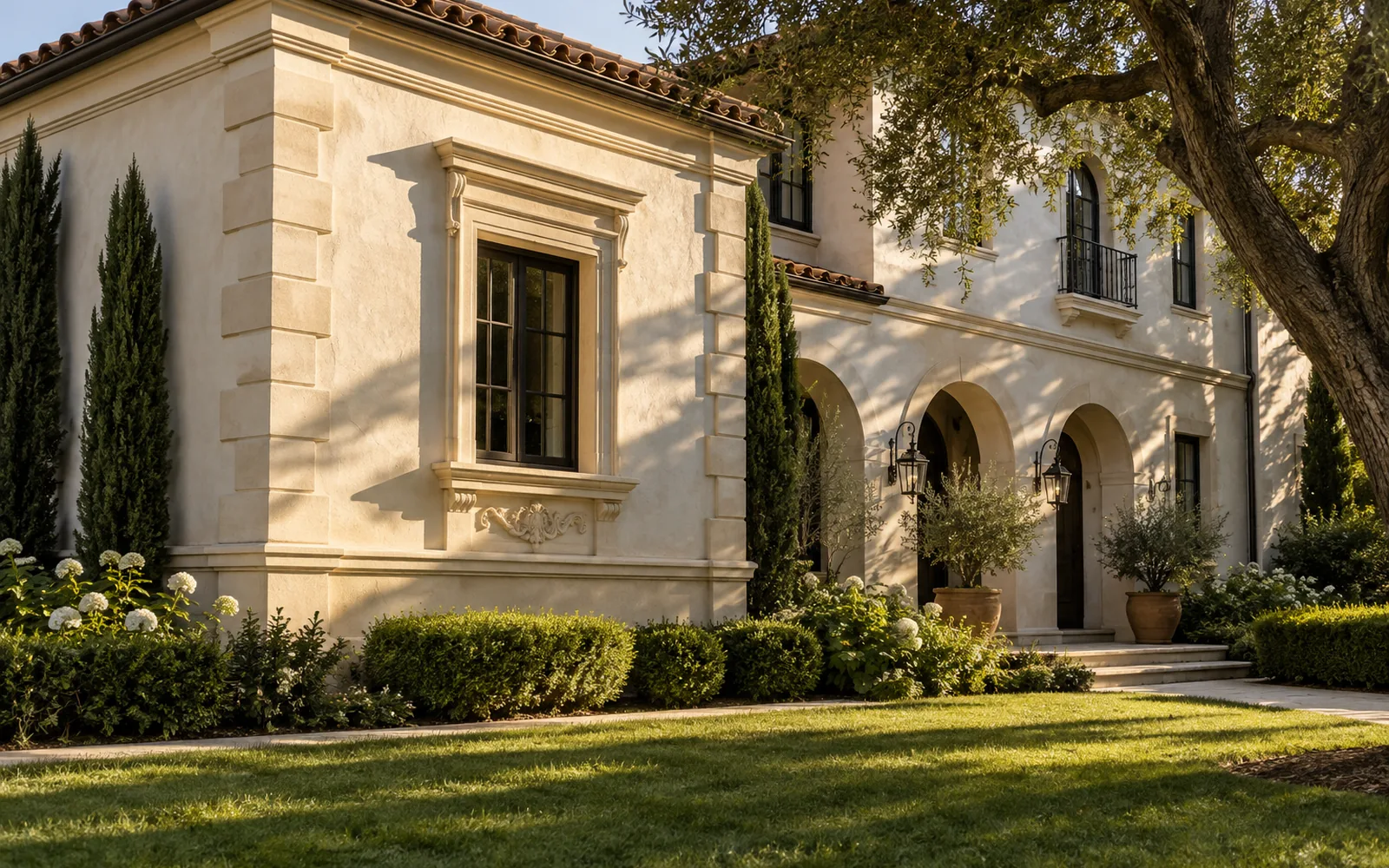
Cream stucco home with ornamental window surrounds behind a lawn

We shape plaster details such as bands, sills, window surrounds, corbels, quoins and score lines. The trim is coated as part of the plaster system, so it becomes one surface with the wall. Reveals are the recessed lines that break up a large wall surface, and they are laid out before the finish coat so the detail sits in the plaster. A modest amount of trim suits a plain farm-town elevation.

Interior Stucco

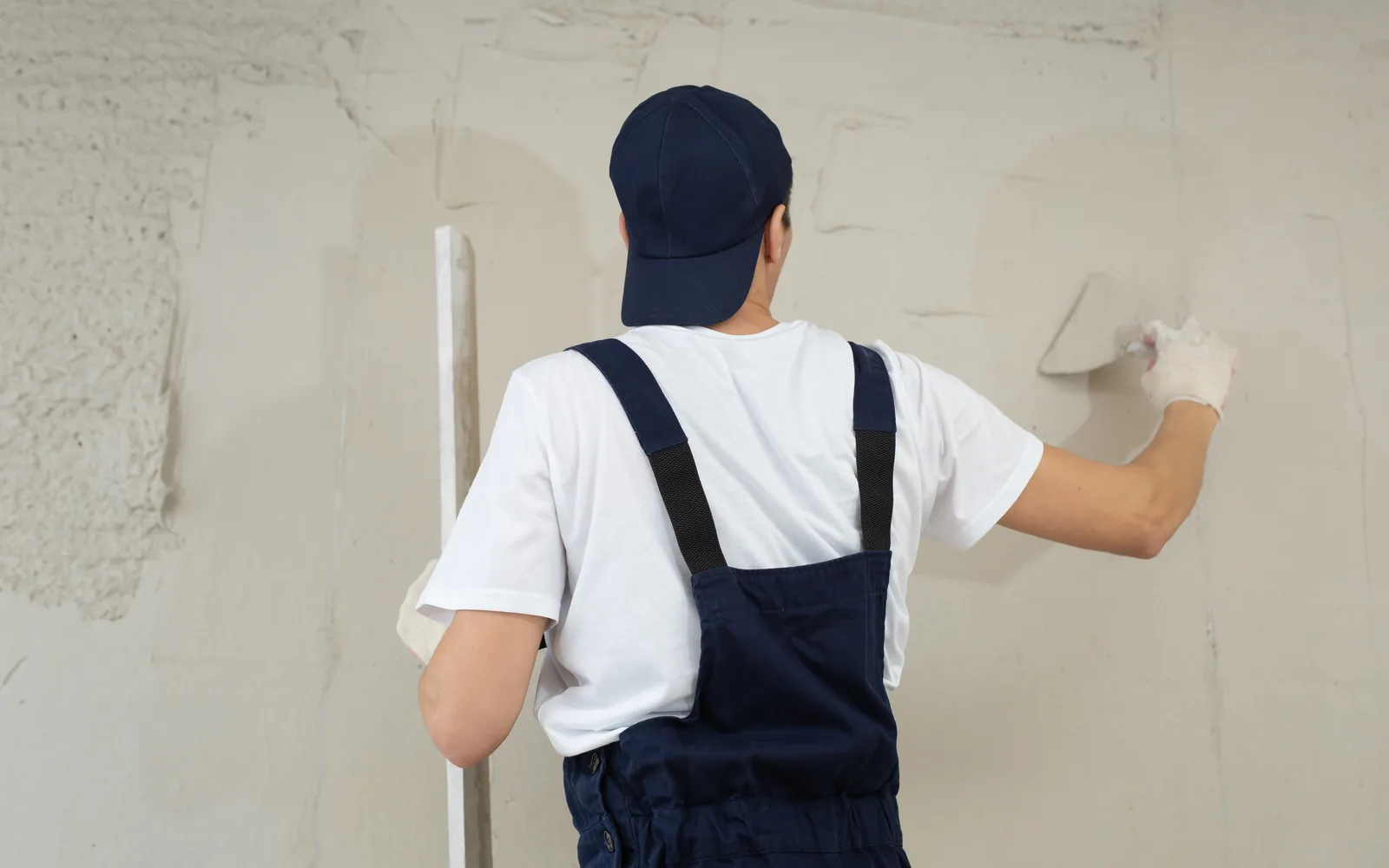
Plasterer smoothing an interior wall with a trowel

Interior walls and fireplace surrounds take plaster finishes too, for rooms where you want a hard troweled surface instead of paint. Mineral plaster is a lime or cement-based material that colors the room through the finish itself. A hand-troweled finish takes its final surface from the trowel, which leaves the slight variation you see across the wall. In an occupied house, we contain dust and protect floors so our work doesn't disturb the rest of your house.

Stucco Resurfacing

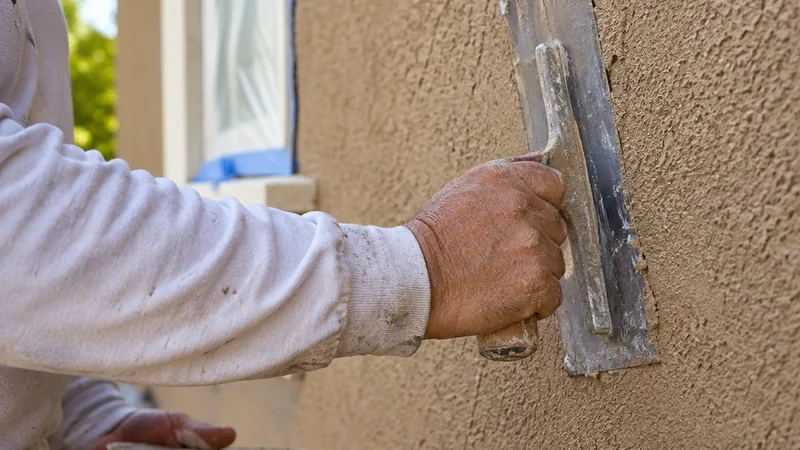
Troweling an integrally colored acrylic stucco finish

A wall can be sound and still look tired, chalked pale by sun or marked by old patches, and that wall needs a new finish instead of a tear-off. A redash is a fresh finish coat with real thickness, troweled or sprayed over sound plaster, and it restores both the texture and the color. A coating is a paint film on the surface. A fog coat is a thin cement wash that recolors a wall without sealing it. Before the wall is dashed, we match the texture from a sample so the long valley-floor sun does not leave one elevation looking separate from the rest.

What a Stucco Contractor Deals With on Biggs Walls

Stucco work in Biggs often takes place beside ground that is intentionally kept wet. Flood irrigation puts the surrounding fields under water during the growing season, so a stucco contractor here has to account for damp soil and humid air as normal working conditions. Both can affect the walls and the way moisture moves around the exterior.

Applying a stucco coat over metal lath

Working Around the Rice Irrigation Calendar

Rice fields are held under water through the growing season, then drained ahead of harvest so the ground can carry a combine. Many go back under water afterward to rot the straw down. That cycle changes the air around your house. Relative humidity is the amount of moisture the air is holding, and when it stays high, water leaves fresh plaster slowly and a finish coat sets late. Dry heat does the opposite and pulls water out of the coat faster than it should leave.

We try to book your job for the stretch between those two, when the air is steadiest for curing. Moist curing, keeping new plaster damp while it hardens, is easier to hold in that window. We also work west in Glenn County, in Hamilton City, where the irrigation year sets the same pace.

Where the Wall Meets the Ground in Rice Country

The bottom of your wall needs a clear path for water to leave. A weep screed is the metal edge run along the base of a stucco wall, and it lets out water that has gotten behind the plaster and onto the water-resistive barrier. The code minimum is 4 inches of clearance to the earth, and 2 inches where the wall meets paving. A raised planting bed, added soil or a new path laid up against the house can bury it, and a buried edge keeps the wall base wet through months when the ground nearby is already carrying water. Irrigation heads aimed at plaster do the same damage more slowly.

About Biggs, California

Biggs began in 1871 as Biggs Station, a stop named for Major Marion Biggs, and incorporated as a general law city in 1903. Fires in 1878 cleared much of the young town, and what went back up went up in brick. That rebuild is why masonry still lines B Street, the main street, where the Colonia Building, a hotel that opened in 1905, stood closed for decades before its restoration. A Carnegie grant put a library on the same street in 1906.

The Butte County Canal reached the area in 1905, and the irrigated ground it feeds still runs up to the edge of town. Biggs covers about 0.9 square miles at roughly 98 feet above sea level, fewer than 2,000 people live here, and the two schools are Biggs High School and Biggs Elementary School. If you own a wall in this town, its age and the flat, watered ground under it both set what it has to withstand.

Where We Work In and Around Biggs

Downtown Biggs sits inside the city limits, and Richvale is a country community out among the fields north-northwest of town. Gridley, the next town south, is about three and a half miles away. As a local stucco company, we work both kinds of ground, and each one asks for something different from us.

Downtown Biggs: We Inspect a B Street Storefront Before Quoting It

The commercial core of Downtown Biggs runs along B Street from Fifth to Seventh. The city has its own downtown plan for rehabilitating existing buildings and filling empty storefronts, and the Colonia Building is the worked example of that plan. A storefront here can be original brick, a later cement render over brick, or paint over either surface. We inspect before we quote, using a moisture meter and tap test as needed, so the scope is written against the wall you actually have.

Richvale: Resurfacing Weathered Walls Near Biggs

Richvale is a separate census-designated community of about 230 people, roughly six miles north-northwest of Biggs. Richvale Elementary sits in the Biggs Unified School District, which is one local tie between the two places. Adobe clay there holds water well enough to keep a paddy flooded, and ground that holds water keeps a wall base damp longer. We resurface and redash weathered walls in Richvale when the finish coat has gone chalky and the plaster underneath is still sound.

One-coat stucco base applied in a single pass Written stucco scope and estimate on a clipboard

Biggs Property, Access and Local Conditions

A Biggs stucco specialist usually encounters one of two job sites: a tight in-town lot, or a building reached across farm ground. The plaster work is the same either way. What changes is where we park, where we mix and how we protect whatever stands close to the wall.

Crew applying a stucco finish coat to a wall

Where the Mixer and Scaffold Go in Town

Biggs covers about 0.9 square miles, and the older lots inside it sit close together with fences and neighboring houses on both sides. That leaves little spare ground, so the scaffold, the mixer and the pallets of material are placed on your property before the first day, which usually means your driveway or side yard carries them until the work is finished. When the street side is the only workable approach, a city encroachment permit gives written permission for equipment to stand in the public right-of-way. Sheeting goes up on the neighboring side, and the site is swept before the crew leaves each day.

Reaching a House Out on Farm Ground

Houses, shops and outbuildings outside the grid are reached by field roads, farm crossings or long private drives. Soft ground after a wet spell changes what can be driven close to the building, so we look at the approach during the estimate visit and stage material near the wall to keep loaded trips down. The same planning covers shop walls and pump houses, where the nearest firm surface may sit well back from the work.

Use the quote form to book a look at your property, and we will walk the approach with you.

Permits and Sign-Offs on a Biggs Stucco Job

A stucco contractor in Biggs may deal with the city counter for one part of a project and the county building side for another. That split has to be sorted out before we schedule the job, because a wall cannot be covered when an inspection is still waiting.

Which Counter Handles Your Permit

The City of Biggs contracts its building permit and inspection services to Butte County, and it keeps its own planning counter. That counter handles planning-side applications such as site plan review, conditional use permits, variances, fences and encroachment permits. Whether your job needs a building permit is confirmed with the Butte County Building Department before a start date is set. Inspections are booked through the county system against the permit number, so the county's own lead time sets when an inspector reaches the property. On new work, the lath inspection is the hold point, and nothing covers the metal lath until that inspection is signed off.

What License a Stucco Contractor Needs in California

The Contractors State License Board defines the C-35 Lathing and Plastering classification around lath, metal stud channel work, and plaster coatings. That classification describes a trade, never any one company, and it grants no permission from Biggs or Butte County. Small cosmetic patches may fall within limited handyman work, while larger projects generally require a properly licensed contractor. When you compare bids, ask each bidder which classification they hold and which parts of your scope fall under it. Two bids can cover different work, and the classification tells you which one matches the job you want done.

Stucco Plastering in Biggs

Stucco plastering on a garden wall, a chimney or a porch ceiling uses the same materials as the plaster on your house wall, but a house wall meets the weather on its outer face only. A freestanding wall is exposed on both faces and along the top, so its plaster usually goes first.

Plaster on the Older Solid Walls Around Biggs

Older garden walls, site walls and outbuildings here are usually solid masonry, built of brick all the way through. Cement plaster or lime plaster grips that brick directly, with nothing behind it to drain water away. A framed wall carries its plaster on lath over a barrier that sheds whatever gets past the surface. Stucco masonry therefore fails differently. When a coat lets go of a solid wall, water is usually sitting inside the brick and has to leave before new plaster will hold. We check for that first, then prepare the surface and apply a bond coat so the fresh plaster grips. Where an old lath and plaster exterior sits on sound backing, we restore it.

Garden Walls, Chimneys, Parapets and Porch Ceilings

A garden or site wall is plastered on two faces and capped along the top. That cap, the coping, sheds rain off the top edge, and once it cracks water runs down inside the wall. A parapet is a short wall standing above a roof edge. Parapets and chimneys are weathered on every side and move more, so their plaster opens sooner. Soffits and porch ceilings take dirty runoff when a gutter above them overflows, which leaves streaks across the finish. If your wall stands free in irrigated ground, water reaches the plaster from below as well.

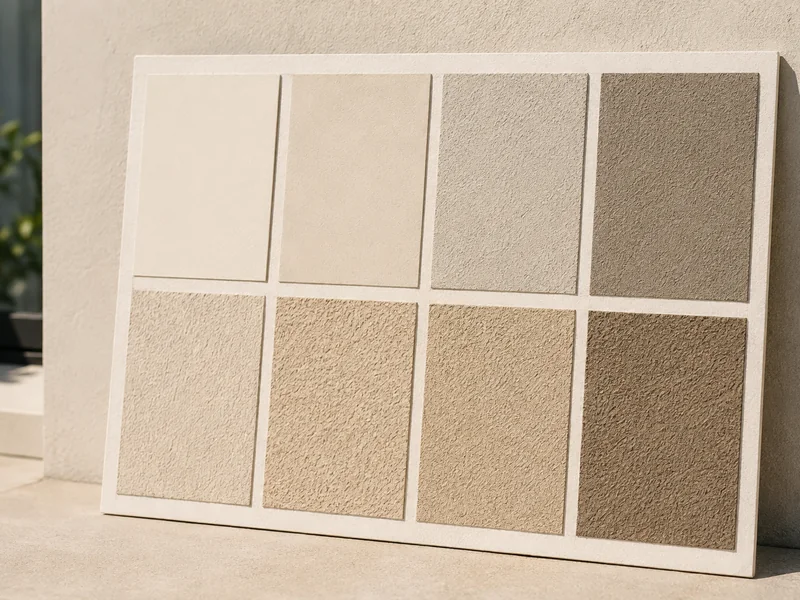
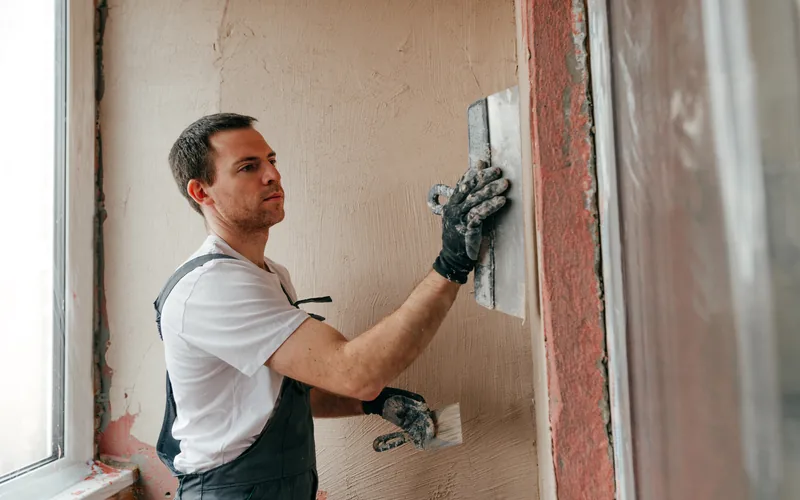
Sample board of stucco textures and colors Plastering an interior wall around a window in an occupied room

Stucco Questions From Biggs Property Owners

How close to the ground can stucco stop on a house in Biggs?

Plaster is held clear of the ground so that water standing at the base cannot soak up into it. On a house here that means finishing at least 4 inches above earth and at least 2 inches above paving. Where soil has already buried the bottom edge and the weep screed, cut the ground back to reopen that gap before anything is patched or coated.

Does the irrigation season change when you can stucco a house here?

Yes, irrigation shapes the booking, but it does not rule stucco siding work out. Book the estimate visit ahead of the window you want, so the wall, the ground and the schedule can all be checked before a crew date is set.

Does the damp air around flooded fields affect how stucco cures?

It changes the pace of the job and not the result. Humid air holds water in a fresh coat for longer, so the gap before the next one widens on a wet week. We wait it out rather than push a coat onto one that is not ready, and your written scope records that pacing before the work starts.

Who issues the building permit for stucco work in Biggs?

The Butte County Building Department handles the building side, even though Biggs is its own city. The same department applies inside the city limits and on farm-ground parcels around them.

Is damp at the bottom of my wall rising damp or a leak?

Where the damp sits on the wall usually tells you which one it is. Moisture drawn up from the ground fades as the wall gets higher, while a leak follows an opening or a joint. Note whether the damp area appears after rain or holds through a dry spell, and you will have told us most of what we need.

Do you work in Biggs itself, or only around Chico?

Yes, Biggs is inside the area we cover. A small job here is grouped with other work on this side of the county, so a short piece of repair is worth asking about.

Get a Free Stucco Estimate in Biggs

We start a free estimate with a visit to look at the wall, the ground at its base and the access around the property. After that visit, you receive a written scope that names the wall system and finish so the price is tied to the work being quoted.

Call (530) 783-7384 or use our quote form now for a free estimate.